The best window tint for your car depends on what you want from it: a cooler cabin, a particular appearance, glare reduction, privacy, or a lower installed price. Film names such as ceramic, carbon, dyed, and “premium” can help narrow the choices, but they do not guarantee the same performance across brands. Compare the exact film series and its data before you choose.
Quick picks: For heat control, compare ceramic or other high-performance films by their published solar data. For style on a tighter budget, compare color-stable or dyed lines. If you want a lighter appearance, compare high-VLT or clear films and check the product’s heat-performance figures. No category is best for every car or driver.
Car window tint types compared
| Film style | Often considered for | Potential trade-off | Best comparison |
|---|---|---|---|
| Dyed or color-stable | Appearance, glare reduction, and a more accessible quote. | Heat performance varies widely by product; some color-stable lines combine dye with other technologies. | Warranty, color stability, VLT, and TSER. |
| Carbon | A charcoal look and an alternative to basic dyed films. | “Carbon” does not specify a universal performance level or formula. | Exact product data, color, warranty, and price. |
| Ceramic or IR-rejecting | Drivers comparing heat-rejection options, including lighter shades. | Often quoted at a higher price; “ceramic” alone does not tell you how well a film performs. | TSER, IRER or clearly defined IR data, VLT, and glass test conditions. |
| Multilayer optical or clear high-performance | High solar performance with less change to the vehicle’s appearance. | Usually a premium option; available VLTs and appearance differ by product. | Solar data at the VLT you want and any local glass rules. |
| Metalized or reflective | A more reflective style or a product designed around a metallic layer. | Reflectivity and possible signal compatibility should be checked for the exact film. | Interior/exterior reflectance and manufacturer guidance on electronics. |
These categories are broad descriptions. Product lines can combine technologies, and claims should be checked against the maker’s technical data and warranty.
Which window tint is best for heat rejection?
Start with the data sheet, not how dark the film looks. Ask the installer for total solar energy rejected (TSER) and the manufacturer’s infrared metric for the exact shade. TSER estimates how much total solar energy the tested film-and-glass setup rejects. Infrared figures may use different wavelength ranges and methods, so only compare like-for-like measurements.
For a specific example, 3M describes Crystalline as a multilayer optical film and says it can reject more heat than many darker films without changing a car’s appearance. Its Ceramic IR line is described separately. These are claims for named 3M products, not proof that every multilayer or ceramic product performs the same. Review the 3M automotive film series and data and compare it with the product you are quoted.
What do VLT, TSER, and IRER mean?
- VLT (visible light transmission): The percentage of visible light that passes through the glass. A lower VLT usually looks darker. The vehicle’s factory glass affects the finished VLT.
- TSER (total solar energy rejected): A measure of solar energy rejected by the tested film-and-glass combination. Check the stated glass and test method.
- IR rejection or IRER: Infrared performance figures can be defined differently by different brands. Read the wavelength range and measurement notes before comparing percentages.
- UV protection: Review the tested UV range and the maker’s stated protection for the exact series; do not infer UV performance from darkness.
- Visible reflectance: Helps describe how reflective the film looks from inside or outside, which can affect appearance and nighttime viewing.
How to choose the best tint for your car
- Decide your main goal. Rank comfort, appearance, privacy, glare reduction, connectivity, and price so you can compare options that address what matters to you.
- Choose a legal VLT for each window. Rules vary by state, window, and vehicle. Check a current official source for your location and confirm how the finished glass is measured.
- Compare exact film series. Ask for the manufacturer, series, shade, technical data sheet, and written warranty. “Ceramic” or “carbon” by itself is not a complete quote.
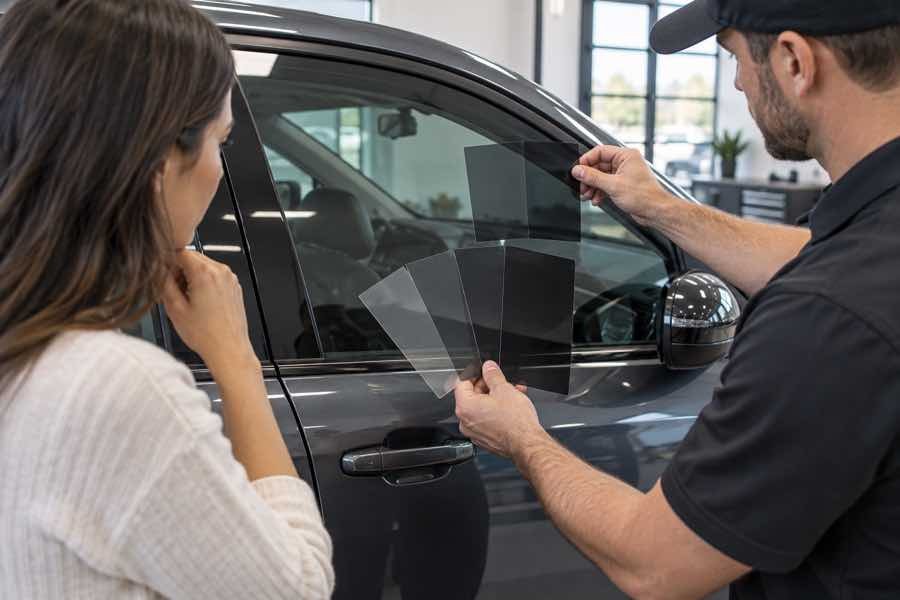
- View a sample on your vehicle. Factory glass color and lighting change how a shade looks. View it outside and from the driver’s seat.
- Compare complete installed quotes. Confirm which windows are included, whether old film removal costs extra, and whether the quote includes a warranty.
- Ask about electronics. If you use GPS, satellite radio, toll devices, or mobile connectivity, ask whether the product is metalized and what its maker recommends.
Questions to ask before buying
- What is the exact manufacturer and film series?
- What are the VLT, TSER, and defined infrared results for the shade I selected?
- What type of glass was used for those test values?
- What final VLT do you expect with my vehicle’s factory glass?
- What does the written warranty cover, and who handles a warranty claim?
- Can I see the shade on similar glass before installation?
If you are comparing DIY choices, browse automotive window tint film kits and confirm the product is made for your exact vehicle and window. Some links in this article are affiliate links. As an Amazon Associate, Window Tint Locator earns from qualifying purchases.
Want a professional recommendation? Browse the Window Tint Locator listings. Ask nearby shops to quote the same VLT, film series, windows, and warranty so the prices and performance are easier to compare.
Leave a Reply
You must be logged in to post a comment.