
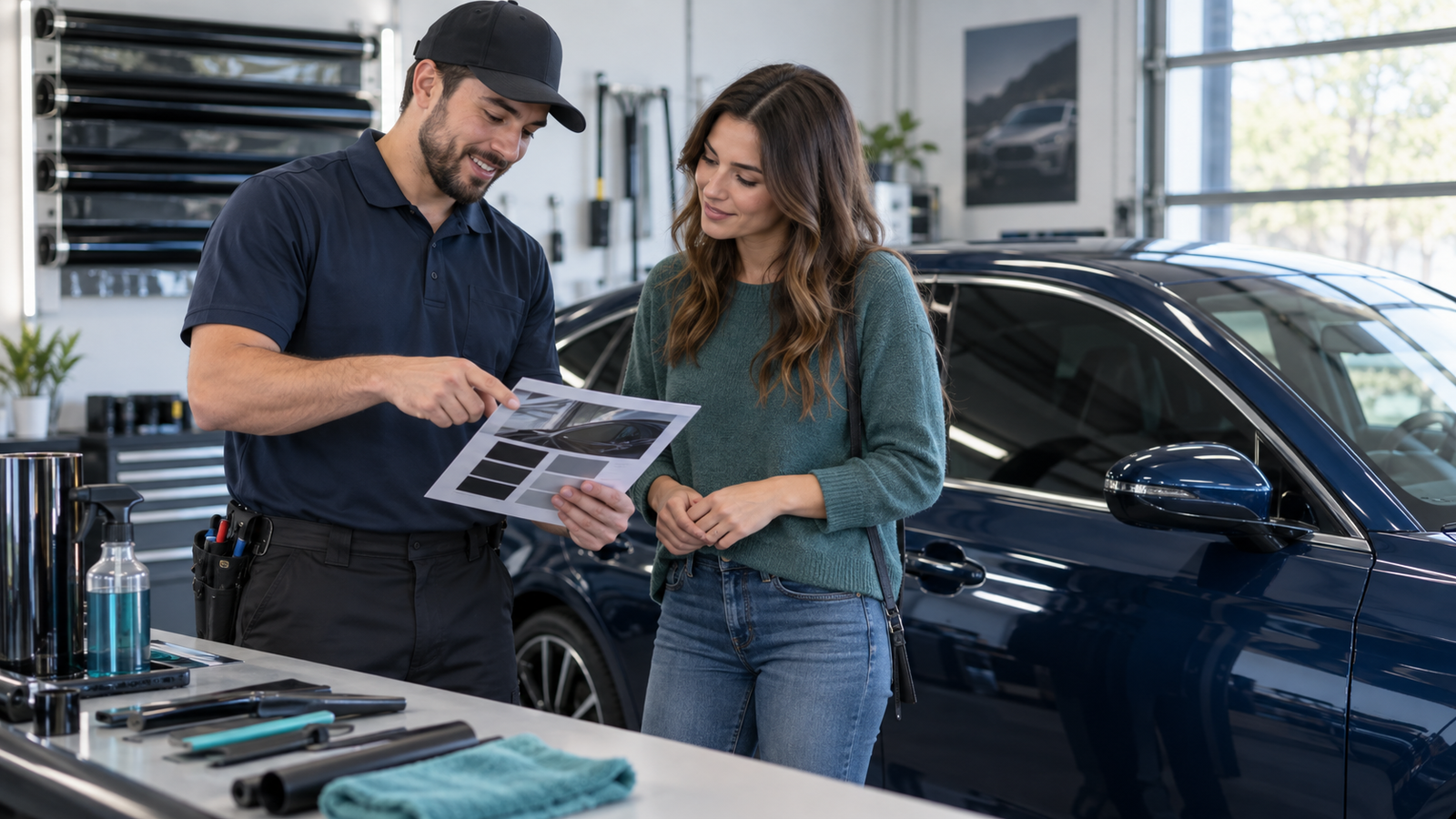
A window tint quote can sound impressively simple: “Full car, $399.” Then you ask what film it includes, and suddenly the conversation has more plot twists than a courtroom drama. Is it ceramic? Which ceramic? Does “full car” include the windshield strip? Is old film removal extra? What happens if a window has a bubble the size of a grape?
Choosing a tint shop is about more than picking the lowest number or the darkest sample. You want a clear product, a careful installation, a written warranty, and a result that fits your vehicle and local rules. A little comparison up front can save money, time, and a return visit with a heat gun.
Quick checklist: Get the exact film brand and series, list the windows included, confirm final VLT and legal compliance, ask how the shop handles preparation and curing, and compare written warranties and removal charges. Then compare quotes for the same job.
The simplest rule: A good shop can explain what it is installing, show you the manufacturer’s performance data, describe the warranty, and put the details in writing—without making you feel like you need a chemistry degree or a decoder ring.
1. Ask for the exact film brand and series
“Ceramic,” “carbon,” and “premium” are broad labels, not product names. Two shops can use the same category word while quoting different products, warranties, and performance. Ask for the manufacturer and exact series on the estimate. Then look up the manufacturer’s technical sheet and see whether the shop can show the same film sample they plan to install.
For performance, compare figures that describe the filmed glass, such as VLT (visible light transmission) and TSER (total solar energy rejection). Be careful with an impressive infrared rejection percentage if it does not clearly explain the test method or whether it measures film alone or the film on glass. Exact data is more useful than a sales pitch that treats a single number as the whole story.
2. Make sure every quote covers the same windows
“Full car” is not a universal package. Does it mean the four side windows and rear glass? Is the windshield excluded? Is a sunroof included? Is there a separate charge for a top windshield strip? Does the quote include removing old film?
List the windows you want treated and ask each shop to quote the same coverage. If you have factory privacy glass, ask whether the shop recommends adding film over it and what the final shade will be. The film’s advertised VLT can combine with the original glass to create a darker finished result. Our guide to factory privacy glass vs. aftermarket tint explains that difference.
3. Confirm the finished shade and local rules
Tell the shop where the vehicle is registered and driven, and ask how the proposed film fits the requirements for each window. Windshields, front side windows, rear side windows, and the back window may have different limits. Also ask about reflectivity, colors, and medical exemptions if any apply to you.
Request an estimate of final VLT over your existing glass—not just the film’s package label. Ask whether the shop can measure the glass before installation and document the finished reading. A confident “this shade is legal everywhere” is a red flag: rules vary by jurisdiction and can change. Use our window tint law research checklist to verify local requirements.
4. Ask who does the installation
Find out whether the work is performed by the shop’s own installers, a subcontractor, or a mobile technician. Ask how long the team has been installing automotive film and whether the installer has manufacturer training or authorization for the product being quoted. Credentials alone don’t guarantee a perfect job, but the shop should be able to explain who is responsible for the work and how to reach them if an issue appears.
Look at recent examples of vehicles similar to yours. A compact sedan, a frameless coupe, and a vehicle with steep curved glass can each present different fitting challenges. Reviews are useful, but look for details about communication, cleanliness, fit at edges, and how the business resolved problems—not only star ratings.
5. Understand the preparation and installation process
Ask how the shop cleans the glass and protects your interior. A professional installer should be able to describe the prep steps, how the film is cut and fitted, and how the vehicle is handled while the work is curing. Ask how long the appointment usually takes and whether you should remove child seats, valuables, or items from the trunk.
Find out when you can roll the windows down, clean the glass, or wash the vehicle. Follow the installer’s instructions because cure time depends on the product and conditions. If the shop says “do whatever” before you leave, ask for the manufacturer’s written care directions.
6. Read the warranty before you pay
“Lifetime warranty” sounds reassuring, but it is only useful if you know what it covers and how a claim works. Ask whether the manufacturer covers bubbling, peeling, cracking, color change, or adhesive failure. Does the warranty cover labor as well as film? Does coverage transfer if you sell the car? Is the installer authorized for that product? Are there regional or registration requirements?
Get the warranty terms and proof of installation. Keep the receipt, film series, installation date, and any warranty card with your vehicle records. If a shop relies on a verbal promise, ask where the written terms are before booking.
7. Compare the quotes side by side
| Quote detail | Shop A | Shop B |
|---|---|---|
| Film brand and series | Write the exact product | Write the exact product |
| Windows included | List every window and any strip | List every window and any strip |
| Removal, taxes, and fees | Note what is included | Note what is included |
| Final VLT and warranty | Record the estimate and terms | Record the estimate and terms |
| Aftercare instructions | Record wait times and care steps | Record wait times and care steps |
Once the work is genuinely comparable, the price guide can help you understand why estimates differ. See how much car window tint costs before deciding that the lowest quote is automatically the best one.
Red flags worth noticing
- The shop refuses to name the film manufacturer or series.
- The quote says “full car” but does not list the windows.
- The installer guarantees legality without asking where the vehicle is driven.
- The price changes sharply when you ask about warranty or removal.
- The shop pressures you to choose the darkest shade immediately.
- The staff cannot explain aftercare or who handles a warranty claim.
- You are asked to pay in full before the product and scope are documented.
One awkward answer is not proof of bad work, but several vague answers together are a good reason to keep shopping. A professional shop should welcome informed questions; you are trusting them with glass you look through every day.
After installation: keep the view clear
Before you leave, confirm when it is safe to lower the windows and clean them. Ask what to do if you notice bubbles, haze, or a lifted edge after the expected curing period. Keep the receipt and warranty details. When the film is ready for cleaning, use soft materials and a product compatible with your film. You can compare tint-safe glass cleaners and microfiber cloths; check the label and the film maker’s care guidance. Some links are affiliate links. As an Amazon Associate, Window Tint Locator earns from qualifying purchases.
If you are ready to talk to local installers, browse the Window Tint Locator listings. Send each shop the same vehicle, window coverage, product goals, and questions. Then compare the written answers—not just the first number that lands in your inbox.
A solid shop makes the decision easier. You should know what film is going on your car, which windows are included, how the finished shade will measure, what the warranty says, and what happens if something needs attention. If you can get those answers in writing, you are ready to book with confidence.
Leave a Reply
You must be logged in to post a comment.