Car window tint inspires strong opinions. Your neighbor swears 5% tint turns a sedan into a rolling refrigerator. A forum post says every ceramic film is magic. Someone else insists legal tint is whatever the shop is willing to install. Before the group chat becomes a courtroom, let’s sort seven common window tint myths from the facts.
The short version: Film shade, heat rejection, UV protection, privacy, legality, and signal compatibility are different questions. The useful answers come from the exact film’s data sheet, your vehicle’s glass, and the rules where you drive.
Myth 1: The darker the tint, the cooler the car
Plot twist: Dark is an appearance, not a complete heat-performance rating.
Visible light transmission (VLT) tells you how much visible light passes through the glass. Lower VLT usually looks darker. Heat reduction depends on more than visible light: film construction and published solar performance matter too. A lighter film can reject meaningful solar energy, while a darker film is not automatically the top performer.
Ask for total solar energy rejected (TSER) and compare the exact product series under the same test conditions. 3M, for example, describes its Crystalline series as a film that can reject more heat than many darker films. That claim is specific to that product family, but it shows why shade alone is a poor heat meter. We explain the numbers in our guide to choosing the best window tint for your car.
Myth 2: “Ceramic” means every film is excellent
Plot twist: “Ceramic” is not a universal grade stamped by a tint referee.
Ceramic products can differ by manufacturer, model, shade, price, and test method. Marketing terms alone do not let you compare heat performance. A trustworthy quote identifies the maker and film series, and a useful data sheet explains the test values and the glass they were measured on.
Ask two shops to quote the same window coverage and shade, then compare the product data and warranty. If one quote only says “ceramic,” ask which ceramic. For more detail, see ceramic vs. carbon window tint.
Myth 3: Every dark tint blocks more UV than a clear film
Plot twist: Your eyes are not a UV meter.
VLT describes visible light, while ultraviolet protection is a separate property. Some high-VLT or nearly clear products are designed to block a large share of UVA and UVB. The Skin Cancer Foundation says UV-protective window films can block more than 99% of UVA and UVB when properly specified. That figure should not be assumed for every film. Check the exact product’s UV data and what glass combination it applies to.
Darkness also does not tell you the film’s heat-rejection result. They’re separate rows on the product report card. Read our explainer, does window tint block UV rays?, for the difference between film shade and UV performance.
Myth 4: If a tint shop offers it, it must be legal on every window
Plot twist: A shop’s menu is not a state statute.
Tint rules can vary by jurisdiction, vehicle type, and window position. The windshield, front side windows, and rear windows may have different requirements. Some rules use visible-light transmission; others also address reflectivity or special exemptions. A film shade sold in one state may not meet the rule for a particular window in another.
Check a current official state or local source before booking. Ask the installer what finished VLT they expect after the film is combined with your factory glass, and ask how they verify it. If you’re comparing numbers, our window tint percentage chart explains why a film’s printed percentage and the finished window’s reading may differ.
Myth 5: Dark tint gives you privacy at night, too
Plot twist: Daytime privacy has an opponent: light inside the car.
From outside, a shaded window may make the cabin harder to see into in bright daylight. At night, when the cabin is lit and it is dark outside, the view can change. A film’s shade and reflectivity, the light levels on each side, and the angle you’re looking from all affect privacy. A sample card held up at noon cannot promise what the window will look like under a parking-lot lamp.
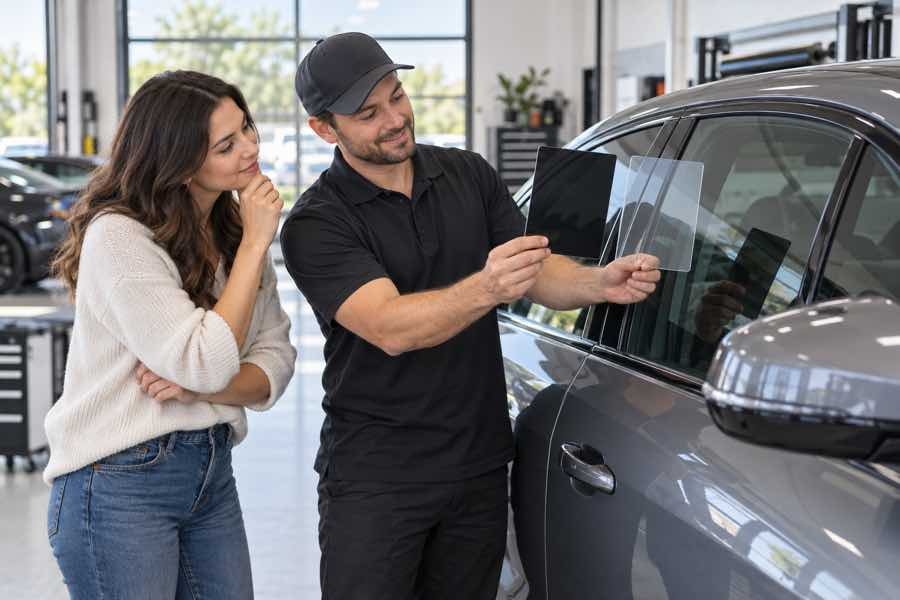
Ask to see film on glass similar to your vehicle’s and view it from inside and outside in different lighting. Also consider whether you need a clear view through the windows at night; visibility is part of the decision, not a footnote.
Myth 6: Tint always interferes with your phone, GPS, or toll pass
Plot twist: That depends on the film’s construction.
Some metalized products may affect certain wireless signals. Many non-metalized films are designed to avoid that issue. For example, 3M states that its non-metalized Crystalline film is designed to avoid interference with phones, GPS, and radio signals; its product information also identifies a metalized film line that may have slight wireless interference. Those examples are product-specific—not a rule that all film behaves the same way.
If you depend on GPS, satellite radio, a toll transponder, or phone connectivity, ask whether the exact film contains metal and what the manufacturer says about signal compatibility. “It’s tint” is not enough information to diagnose a signal problem.
Myth 7: A little haze after installation means the tint is ruined
Plot twist: New film may need time to cure.
Moisture or temporary haze can remain while the installation dries. Cure time depends on the film, glass, weather, and installation conditions. Follow the installer’s care instructions and do not press bubbles, pick at an edge, or clean the glass before the recommended time. If the haze worsens, the film starts lifting, or the installer’s expected cure period passes without improvement, contact the shop that installed it.
3M’s automotive care guide, for instance, says to keep windows closed and avoid cleaning for at least 48 hours after installation. The right waiting period can vary by product, so use your own installer’s instructions. See our guide to cleaning tinted windows safely for aftercare basics.
The one question that clears up most tint myths
Ask: “What exact film series is this, and can I see the data sheet?” Then look for the performance numbers that match your goal: VLT for visible shade, TSER for total solar performance, defined infrared data for infrared performance, UV-block data for ultraviolet protection, and reflectance for appearance. Check the stated test glass and whether the figures describe film alone or a film-and-glass system.
That one question can turn vague claims into a practical comparison. If you want to check an installed window’s visible-light reading, you can browse automotive window tint meters; confirm the meter is suitable for your glass and understand that a VLT reading does not measure heat or UV performance. Some links in this article are affiliate links. As an Amazon Associate, Window Tint Locator earns from qualifying purchases.
Quick myth-busting checklist
- Darker does not automatically mean more heat rejection.
- “Ceramic” by itself does not tell you a product’s performance.
- UV protection cannot be judged by eye or by shade alone.
- A shop’s menu does not establish what is legal for your vehicle.
- Privacy can look different at night than it does in daylight.
- Signal compatibility depends on the specific film construction.
- Fresh film may need time to cure before you judge the finish.
Ready to compare real options? Browse the Window Tint Locator listings. Ask local shops to identify the exact product series, quote the same windows, and show the numbers behind their recommendation.
Leave a Reply
You must be logged in to post a comment.