
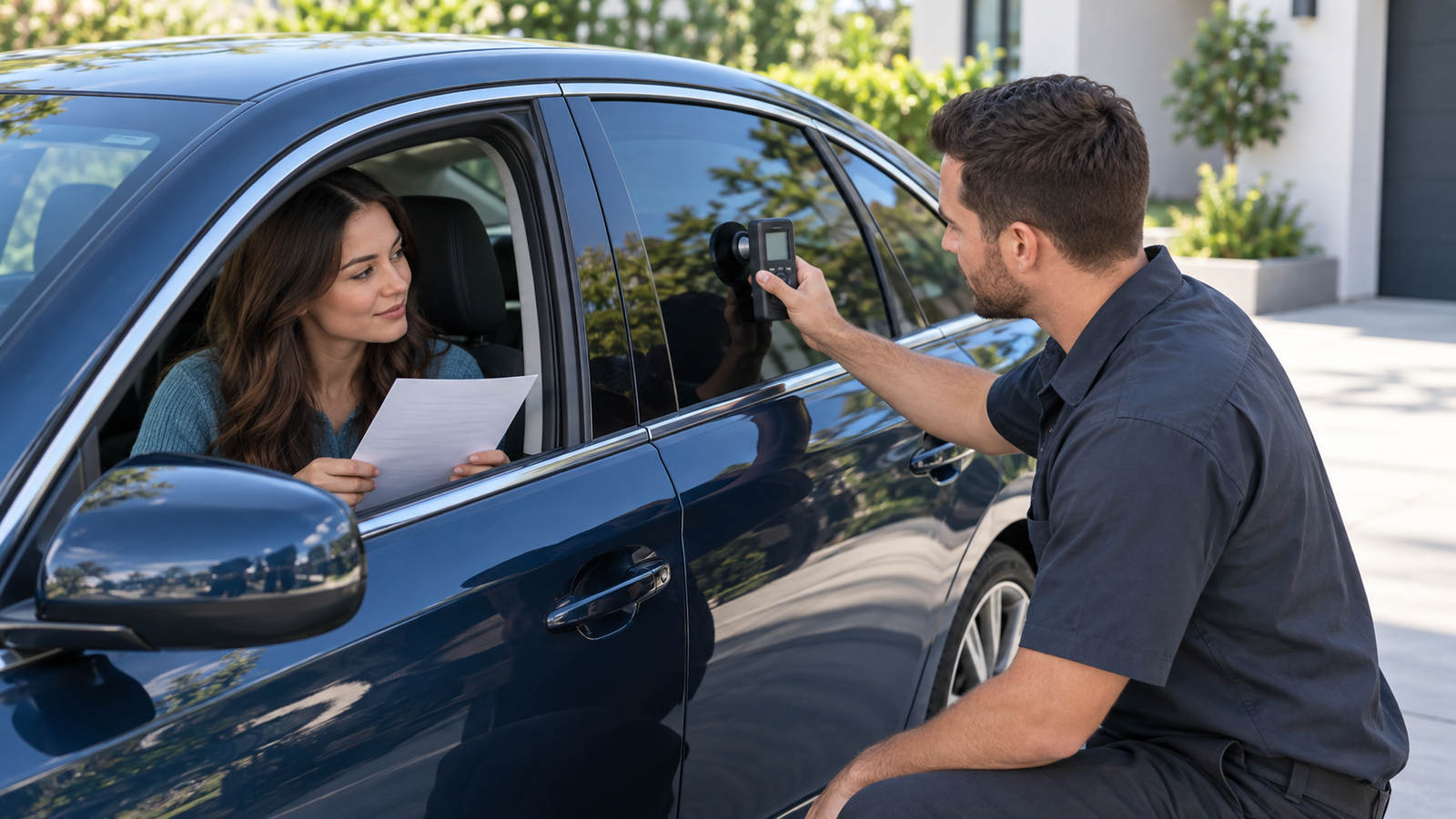
The internet is full of window-tint charts that promise to tell you exactly what is legal in every state. They can be handy, right up until the chart is three years old, leaves out SUVs, or treats a medical exemption like a permission slip that works everywhere. Before you choose a shade, give your state’s actual rules a few minutes. It is less glamorous than picking film colors, but much cheaper than peeling off a brand-new installation after an inspection.
The short version: window tint requirements depend on where the vehicle is registered and driven, which window is tinted, the vehicle type, the glass-and-film combination, and sometimes the vehicle owner’s medical status. Start with an official state source, confirm the details with a qualified local installer, and get the planned film measurements in writing.
Quick checklist: Look up visible light transmission (VLT) for each window, windshield rules, reflectivity and color restrictions, vehicle-class exceptions, medical exemptions, testing or inspection requirements, and whether the rule applies where you live, register, or drive.
Why a tint chart is a starting point, not the final answer
Window-tint law is not one national percentage with a few local footnotes. States set rules for vehicles used on their roads, and the same state may treat a windshield, front side window, and rear window differently. Passenger cars can also be treated differently from SUVs, vans, pickups, or other multipurpose vehicles.
The National Highway Traffic Safety Administration explains that federal glazing standards cover vehicle manufacturing and certain business modifications, while states regulate how vehicles may be registered or operated. NHTSA does not maintain a current list of every state’s aftermarket tint limits. That is why a search result labeled “all 50 states” should send you to primary sources, not end your research. Read NHTSA’s explanation of federal standards and state authority for the federal background.
Step 1: Find the rule on an official government site
Search your state’s official government domains for phrases such as “window tint law,” “sunscreening devices,” “light transmittance,” or “vehicle equipment.” Useful sources include the state legislature’s current code, the department of motor vehicles, the state police, or an official vehicle inspection agency.
A search snippet is not the law. Open the underlying page and check whether it is maintained by the government, when it was updated, and whether it links to the statute or regulation. If the DMV page summarizes the rule, use that summary to find the section number, then read the current statute or regulation itself. When agency guidance and a statute seem to differ, contact the agency responsible for inspection or enforcement and ask which provision applies to your vehicle.
Step 2: Match the rule to each window
Write down the rule separately for the windshield, front side windows, rear side windows, and back window. “The car can have 35% tint” is not a complete answer if the windshield has a separate clear area requirement, or the rear glass has a different limit.
Look for terms such as AS-1 line, top strip, non-reflective material, or a specified distance below the windshield’s top edge. States may also restrict colors or reflectivity even when a film’s VLT meets the number. If the law mentions mirrors, rear visibility, or side windows behind the driver, note those conditions too.
Make sure the rule fits your vehicle class. A pickup or SUV may not be treated the same as a sedan. “Passenger car” and “multipurpose passenger vehicle” can have specific legal meanings; don’t assume your vehicle falls into one category based only on its shape or marketing name.
Step 3: Understand what VLT actually measures
VLT means visible light transmission: the percentage of visible light that passes through the glass. A lower number means darker glass. But the factory glass already has a VLT, and the final reading is affected by the combination of the glass and added film.
That detail catches people. A film advertised as 35% VLT does not necessarily produce a final 35% reading when installed over factory-tinted glass. NHTSA has explained that the glazing-and-film combination matters under federal glazing requirements for businesses. State rules may specify how aftermarket tint is measured and what tolerance applies. Ask the installer to measure the existing glass and provide the expected final reading for each window—not just the film’s box label.
For a refresher on shades and measurements, see our window tint percentage and VLT guide.
| Check | Question to answer | Where to verify |
|---|---|---|
| VLT by window | What minimum light transmission applies to each window? | Current state code or DMV guidance |
| Windshield and reflectivity | Is a top strip allowed? Are reflective or certain-color films restricted? | Statute, regulation, or inspection manual |
| Vehicle class | Does the rule distinguish cars, SUVs, vans, or trucks? | Definitions in the statute and registration |
| Exemptions and proof | Are medical or other exemptions available, and what documents must be carried? | State application and agency instructions |
| Testing and inspection | How is compliance measured, and is there an inspection tolerance? | Inspection agency or official test guidance |
Step 4: Check exemptions before booking
Some states provide medical exemptions or other exceptions. The process may require a particular application, a physician’s certification, renewal, or documentation kept in the vehicle. The exact rules vary, so don’t assume a doctor’s note alone is enough.
Use the state’s own form and instructions. For example, New York’s DMV publishes an official tinted-window exemption application that describes the information required for a qualifying medical condition. That form is a New York example, not a nationwide rule. If you move or travel, ask whether an exemption issued in one state is recognized elsewhere.
Step 5: Ask the shop for numbers, not just promises
Once you find the rule, give the shop the exact window limits and ask for a written quote naming the film series and expected final VLT for every window. Ask whether the estimate accounts for factory glass, whether the installer measures the finished installation, and what documentation comes with the job.
A reputable shop should be comfortable discussing compliance and should not wave away your questions with “we do this all the time.” Ask how it handles a reading near the legal limit, because measurement tools and testing conditions can matter. Some drivers use a VLT meter as a rough check; if you are shopping for one, compare automotive VLT meters. A consumer tool is not a substitute for official testing or legal guidance, and the displayed number alone does not determine compliance. Some links are affiliate links; as an Amazon Associate, Window Tint Locator earns from qualifying purchases.
Keep the quote, invoice, film details, and any exemption paperwork together. Those records can help if you sell the vehicle, need warranty service, or have to answer questions during an inspection.
What if you drive across state lines?
Travel adds another wrinkle. State rules can apply to vehicles operated on that state’s roads, while registration, inspection, and exemption details may depend on where the vehicle is registered. If you regularly commute between states, are moving, or have an unusually dark setup, check with the relevant motor vehicle agencies rather than relying on a forum answer. Ask about both the law and how it is enforced for an out-of-state vehicle.
Your five-minute pre-installation routine
- Identify the state where the vehicle is registered and the states where you regularly drive.
- Find the current official rule and record the source and date you checked it.
- Write down requirements for each window and your vehicle class.
- Confirm final glass-plus-film VLT and any special restrictions with the installer.
- Ask for written product details, the invoice, and any required exemption documents.
Then compare shops using the same film, windows, and requested shade. Our car window tint cost guide can help you compare quotes without treating the lowest number as the whole story. You can also browse local window tint listings and ask each shop the same compliance questions.
The takeaway: Choose a shade after you know the rule for your vehicle and every window. Use current government sources, confirm the finished measurement with your installer, and keep the paperwork. A few careful questions now are far easier than redoing tint later.
Window tint requirements can change and depend on the facts of a particular vehicle. This article is a research checklist, not legal advice. Confirm current requirements with the relevant state agency before installation.
Leave a Reply
You must be logged in to post a comment.